
LinkAhead Data Model#
Note
This page has been migrated from the old documentation, and has not yet been fully revised. There might be inconsistencies or errors when using with current LinkAhead versions.
Introduction#
LinkAhead is a data and knowledge management system that stores it’s data and represents its
knowledge as Entities. The concept of Entity can be thought of as the equivalent to tables,
rows, columns and the tuples that are contained in the tables of a traditional RDBMS. Or, think of
Entity as the key concepts of object-oriented programming languages: Class, Object, Member
Variables are the Entities of Java.
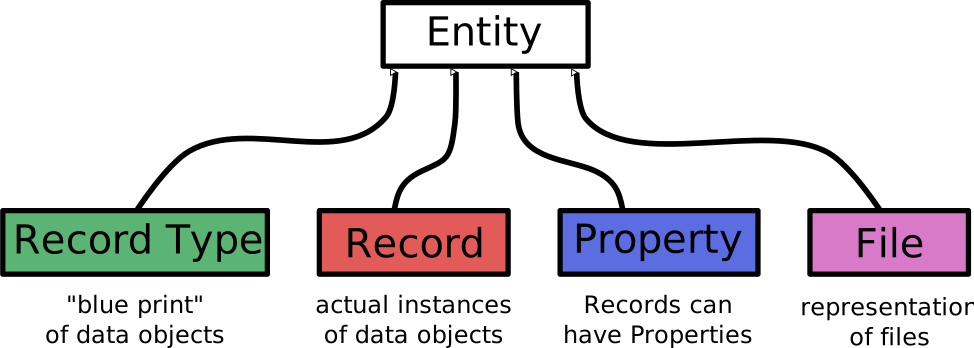
The basic building blocks of the LinkAhead Data Model are shown in the following picture:
Entities#
It has a base object called Entity. Entities are either Record Types, Records, or * Abstract Properties* (and Record like objects for files). What kind of data is stored is defined by the Record Types. Actual data is then stored in CaosDB as Records which are of some Record Type. Those Records can have Properties that contain information about the Record. The following is a more detailed explanation (also see this paper).
Note
Record Types and Abstract Properties are used to define the ontology for a particular domain in which the RDMS (research data management) is used. Records are used to store the actual data and therefore represent individuals or particular things, e.g. a particular experiment, a particular time series, etc.
Record Types#
Record Types define classes or types of things, e.g. persons, experiments, timeseries, etc. Records can be viewed as members of the class defined by its Record Type. These classes can contain Abstract Properties which define key-value relationships for properties of the things along with the expected data type and possibly the default unit, a default value, or a range of permitted values. As files on the backend file system are a major focus of this database management system, there is a special File entity that encapsulates typical file properties like path, size and checksum.
Entities#
Entities can be related via binary, directed, transitive is-a relations which model both subtyping and instantiation, depending on the relation. These relations construct a directed graph of the Entities. If A is-a B we call A the child of B and B the parent of A. No adamant restrictions are imposed on the relate of the is-a relation and thus, Entities can be children of multiple Entities.
Properties#
Each Entity has a list of Entity Properties, or in short just Properties. An Entity Property is
not an Entity of its own, but a triple of an Abstract Property, a value or Null, and an Importance.
The values can be numerals, strings, dates, any other valid value that fits into one of several
builtin data types, or, most notably, references to other Entities. The Importance is either
obligatory, recommended, suggested, or fix. A valid child of an Entity implicitly inherits
its parent’s Properties according to their Importance, which means that it is obliged, recommended
or only suggested to have a Property with the same Abstract Property (or any subtype thereof). As
opposed to Properties with other priorities, Fixed Properties have no effect on the Entity’s
children.
During the creation or update of Entities, the importances of the parents are checked by the server. Missing obligatory Properties invalidate the transaction and result in an error, by default. Missing Properties, when they are recommended, result in a warning, but the transaction is considered valid. Entities with missing suggested Properties are silently accepted as valid. See the detailed specification of RecordTypes for more information on importances and inheritance.
Creating Data Models with PyLinkAhead#
RecordTypes and Properties can be created programmatically using the Python client. When creating a
Property, you must specify a datatype. Available basic datatypes include db.INTEGER, db.DOUBLE,
and db.TEXT. See the full list of datatypes.
# Create a Property of type DOUBLE and insert it
property_a = db.Property(name="a", datatype=db.DOUBLE)
property_a.insert()
Multiple Properties and a RecordType can be combined into a data model and inserted together using a
db.Container.
Property Inheritance#
When creating a child RecordType, the inheritance parameter of add_parent() controls which
properties are automatically assigned from the parent upon insertion:
inheritance = obligatory | recommended | fix | all | none
The server assigns all properties of the parent with the specified importance level (and any higher importance) to the child RecordType automatically. Note that inherited properties are only visible after insertion, since they are set by the server, not the client.
See the importance specification for full details.